
Celebrating three decades of cleaner bathing waters across Scotland
As part of our 30th anniversary series, Ross Haggart, Chief Operating Officer for Regulation, Business and Environment, shares his reflections on the remarkable transformation of Scotland’s bathing waters over the past three decades, from much lower quality ratings in the 1990s to the high standards achieved today.
This progress has been driven by sustained investment, robust regulation and strong partnerships across the country. It also underlines our ongoing role in protecting public health, supporting local economies and providing trusted information that communities can rely on.
This article is adapted from one originally published by The Herald on 4 June 2026 and on SEPA’s LinkedIn page on 11 June 2026. Follow us on LinkedIn.

Ross Haggart, Chief Operating Officer for Regulation, Business and Environment
I've spent much of my career in public service, including a long career with the Scottish Fire and Rescue Service, where decisions are grounded in evidence and focused on protecting people and places.
Since joining SEPA as Chief Operating Officer with responsibility for regulation, I've seen that same principle at the heart of how Scotland manages its bathing waters.
Bathing water quality matters to communities, to people who use these places to relax and connect with the outdoors, and to the local economies they support. With the Scottish bathing water season starting on 1st June, people will be looking for clear information about water quality, what affects it and how it's improving.
A single national scientific and regulatory framework
Thirty years ago, in 1996, bathing waters were brought under a single, national scientific and regulatory framework with the establishment of SEPA. At that point, 45 bathing waters were monitored against a simple pass or fail standard based on a single season, with 41 meeting the required standard and four failing.
That national approach created a consistent evidence base, improved understanding of where pressures were coming from and enabled more co-ordinated action across Scotland.
Over the decades since, monitoring has expanded and standards have become more stringent. Bathing waters are now assessed using four years of data to classify water quality as Excellent, Good, Sufficient or Poor. Using four years of data provides a more reliable picture of water quality over time, reducing the influence of short-term events and reflecting how conditions typically behave.
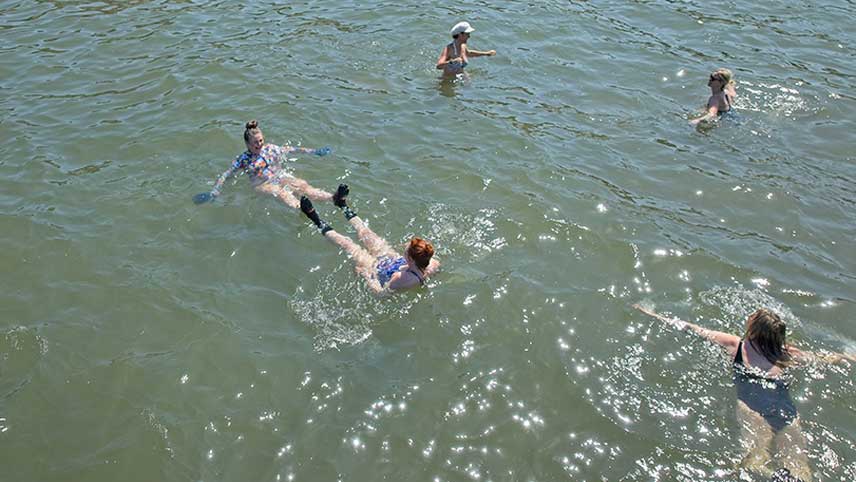
Wild swimming in Scotland's bathing waters is becoming increasingly popular
New bathing water designated
Of the 89 bathing waters monitored last year, 86 met the required standard. A new bathing water at Ballachulish Peninsula has been designated by Scottish Ministers in 2026, bringing the total to 90.
While these figures are not directly comparable, they show that improvement has been achieved alongside a significant expansion in monitoring and a strengthening of standards.
That progress reflects sustained action across whole catchments, guided by science and focused on where it will have the greatest impact.
Reflecting the wider catchment
Bathing waters reflect what is happening across the wider catchment. Water quality at the coast is influenced by wastewater systems, land management, urban drainage and environmental sources. Rainfall is a key factor, as it can increase runoff and place additional pressure on drainage and wastewater systems, particularly during and after heavy rain. These pressures interact and vary from place to place, and conditions can change quickly as water moves through rivers and into coastal areas.
Monitoring provides the evidence to understand these patterns. Samples are analysed using laboratory methods, so results do not provide a real-time picture on any given day. What they do provide is a reliable, long-term view that allows us to identify pressures, track trends and focus effort where it is needed most.
This information is made publicly available on our website, alongside daily predictions based on rainfall and environmental data to indicate when water quality is more likely to be affected, helping people make informed decisions about when and where to bathe.
Using evidence to target action
Understanding the problem is only the starting point. Acting on that evidence is what delivers improvement.
Our role as Scotland’s environmental regulator is to use that evidence to target action. That includes working with Scottish Government, Scottish Water, local authorities, farmers and land managers, businesses and communities to address sources of pollution across catchments and using our regulatory powers where necessary to secure change.
This work takes time. Improvements often depend on changes to infrastructure, land management and behaviour. These are not quick interventions, and they do not happen in isolation.
There are also locations where pressures remain, particularly in more complex catchments where multiple factors combine. In these areas, progress depends on action across different organisations and sectors. If those systems do not align as effectively as they need to, progress can be slower than it should be.
Public service reform
That is why I believe public service reform is essential. Improving environmental outcomes is a shared responsibility, and it is achievable. It depends on how effectively we organise ourselves to deliver it. The progress we have seen in Scotland’s bathing waters over the past 30 years has been built on coordinated action across organisations, sectors and disciplines. But it is about strengthening that approach.
It means services that are simpler, better aligned and focused on delivering results for communities and places. It means bringing together Scottish Government, Scottish Water, local authorities, farmers and land managers around shared outcomes, with a clear focus on where effort will have the greatest effect.
The same is true within SEPA. Improving bathing water quality relies on teams working together across monitoring, science and regulation, alongside specialists in areas such as rural land management. This depends on coordinated effort and a shared focus on outcomes across whole catchments.
After 30 years, the evidence is clear. Scotland’s bathing waters are in a stronger position today because of sustained action across multiple sources of pressure. That progress shows what can be achieved when science, regulation and partnership are aligned.
The task now is to build on that foundation. As pressures on the water environment continue to evolve, so too must how we understand them and how we respond. That means strengthening our use of evidence, sharpening our regulatory focus and working in partnership to deliver the improvements that are still needed.